Case Studies
A deep dive into the problems I've tackled, the design decisions I've made, and the impact behind the work.

Handoff
In ProgressCampus Resale Marketplace — UX/UI Case Study
College students have no safe, student-exclusive way to buy and sell on campus. General platforms like Facebook Marketplace lack identity verification, leading to scams and real-world danger. Handoff solves this with .edu-verified accounts, campus meetup spots, and a trust-first design built specifically for students.
The Problem
College students constantly face a recurring challenge — they need to buy and sell things, but the platforms available to them are unsafe, cluttered, and not built for campus life. Facebook Marketplace is riddled with strangers, scammers, and no accountability. People have been robbed, assaulted, and scammed attempting to use general purpose resale apps because there is zero verification of who you're meeting. For LSU students specifically, there was no trusted, student-exclusive digital marketplace. Handoff was born out of that gap.
Who It's For
Handoff is built for college students, though the model scales to any campus. The users range from incoming freshmen buying dorm essentials, sorority members reselling formal dresses, student-athletes furnishing new apartments, to graduating seniors clearing out years of accumulated items. Every one of these people shares the same need: a fast, safe, trusted way to transact with people they already have something in common with — being a student.
The Story
Our team of five — Hammaad Alam, Fahd Khattak, Demetri Williams, Tyler Gates, and Madison Nguyen — started Handoff as a software engineering course project at LSU. What began as an academic exercise quickly became something we actually believed in. We sat down and asked ourselves: what does a college student actually need from a marketplace app that nothing else provides?
The answer was trust. Not just payment security, but the trust that comes from knowing the person you're meeting goes to the same school as you, has a verified .edu email, and has a reputation within your own community. We wanted to build something where a student could post a listing in under 60 seconds, arrange a meetup at a familiar campus location, and complete the exchange without fear.
I personally led the market analysis — researching competing platforms like OfferUp, Depop, Poshmark, and eBay, identifying their gaps in the college context, and developing a go-to-market strategy centered around LSU move-in and move-out seasons, Greek chapter partnerships, and student organization outreach. The .edu email verification requirement became the cornerstone of our trust model.
My Role & Responsibilities
- Led the full market analysis — researched competing platforms (OfferUp, Depop, Poshmark, eBay) and identified gaps specific to the college context.
- Developed the go-to-market strategy centered around LSU move-in/move-out seasons, Greek chapter partnerships, and student organization outreach.
- Contributed to backend coding and testing of core app functionality.
- Participated in hi-fi and lo-fi design sessions, helping shape the user flow from wireframe to Figma prototype.
- Applied IBM Design Thinking methodology and Cursor AI to accelerate the design-to-development pipeline.
Lo-Fi Design — Where It Started
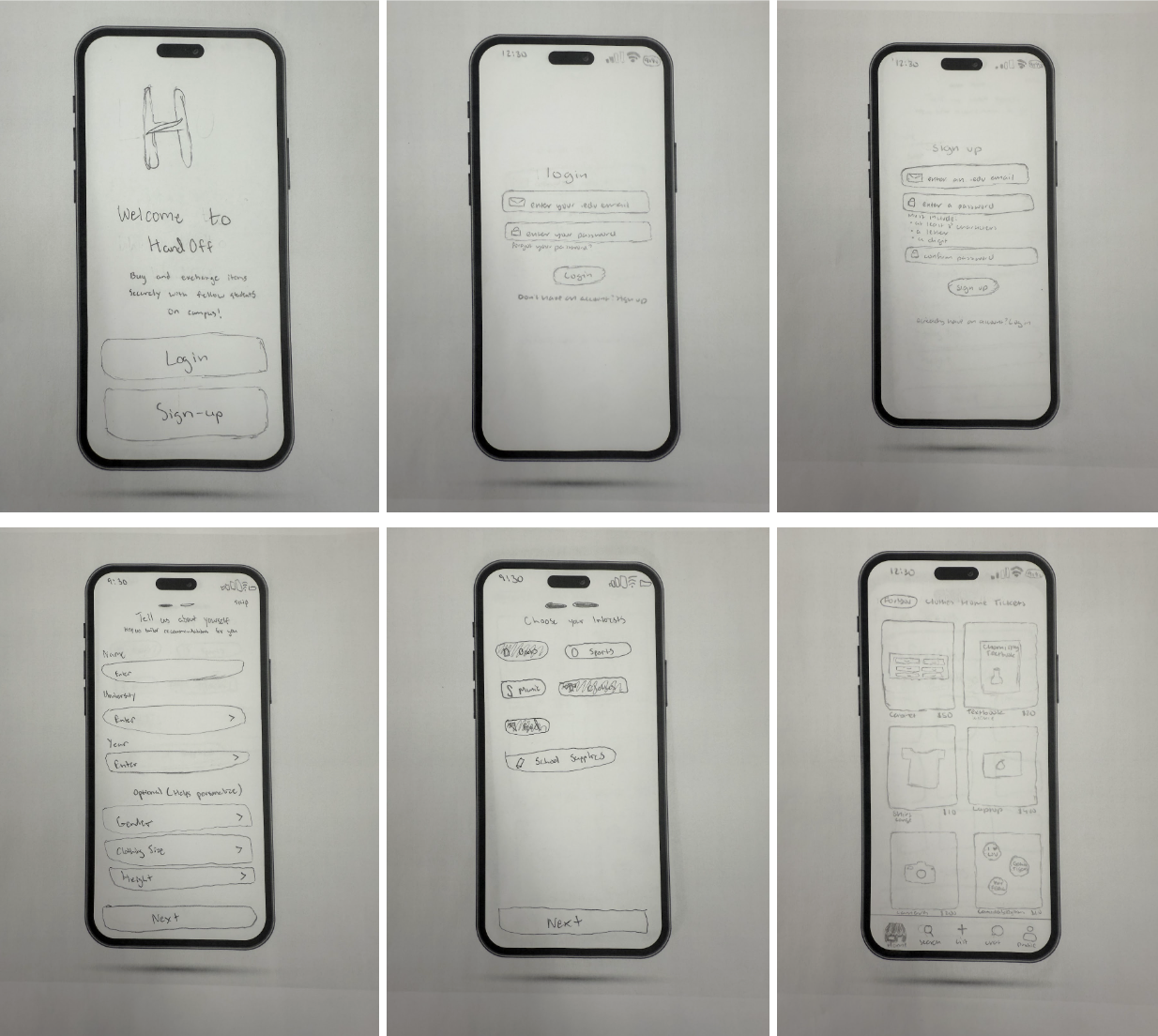
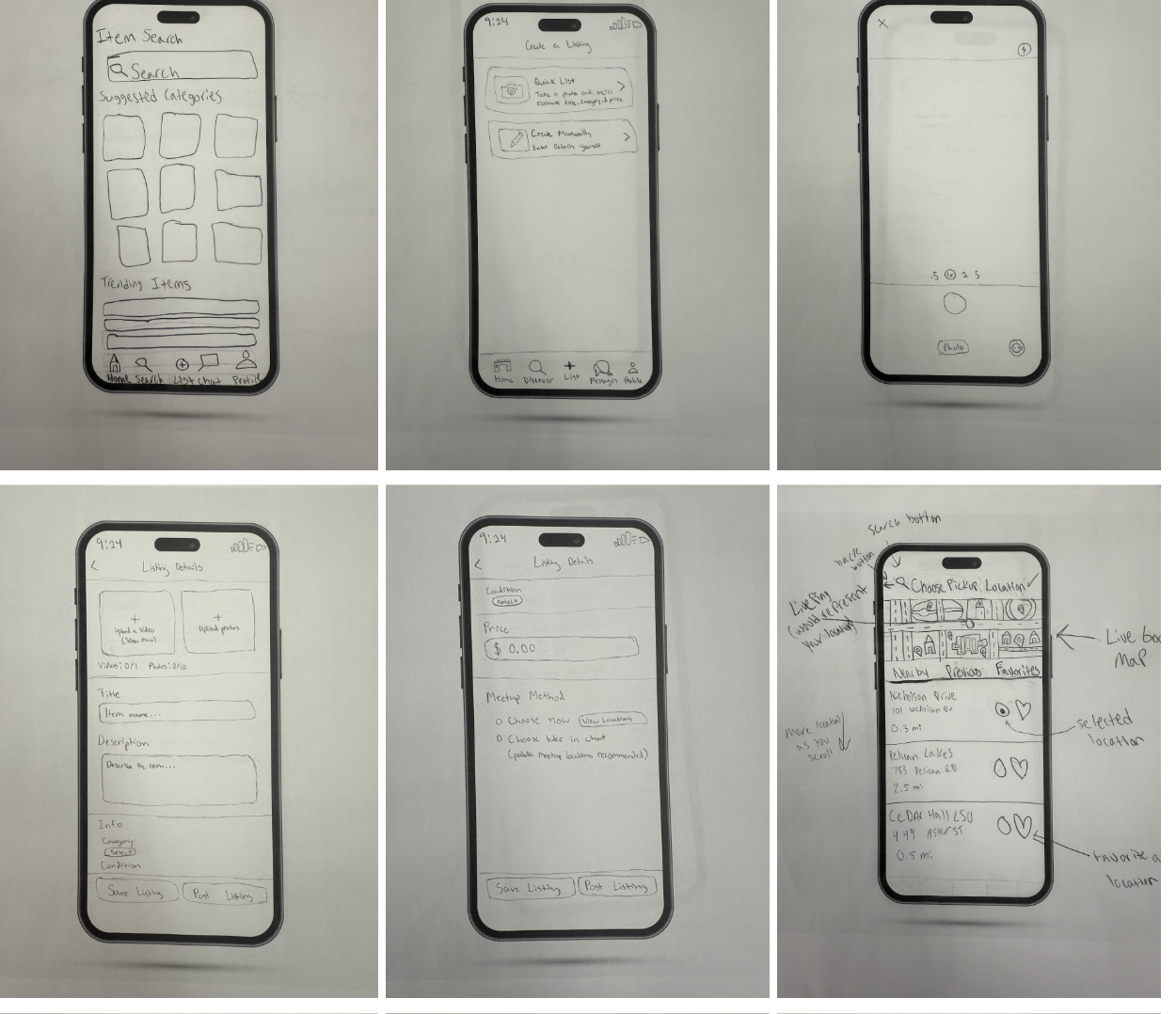
We started with hand-drawn wireframes to map out the core user flows before touching Figma. This included the welcome screen, login, sign up, profile setup, interest selection, home feed, item search, listing creation, listing details, and the campus meetup location picker. The lo-fi phase helped us align on structure and flow before committing to any visual decisions.
Journey Mapping — Understanding the User
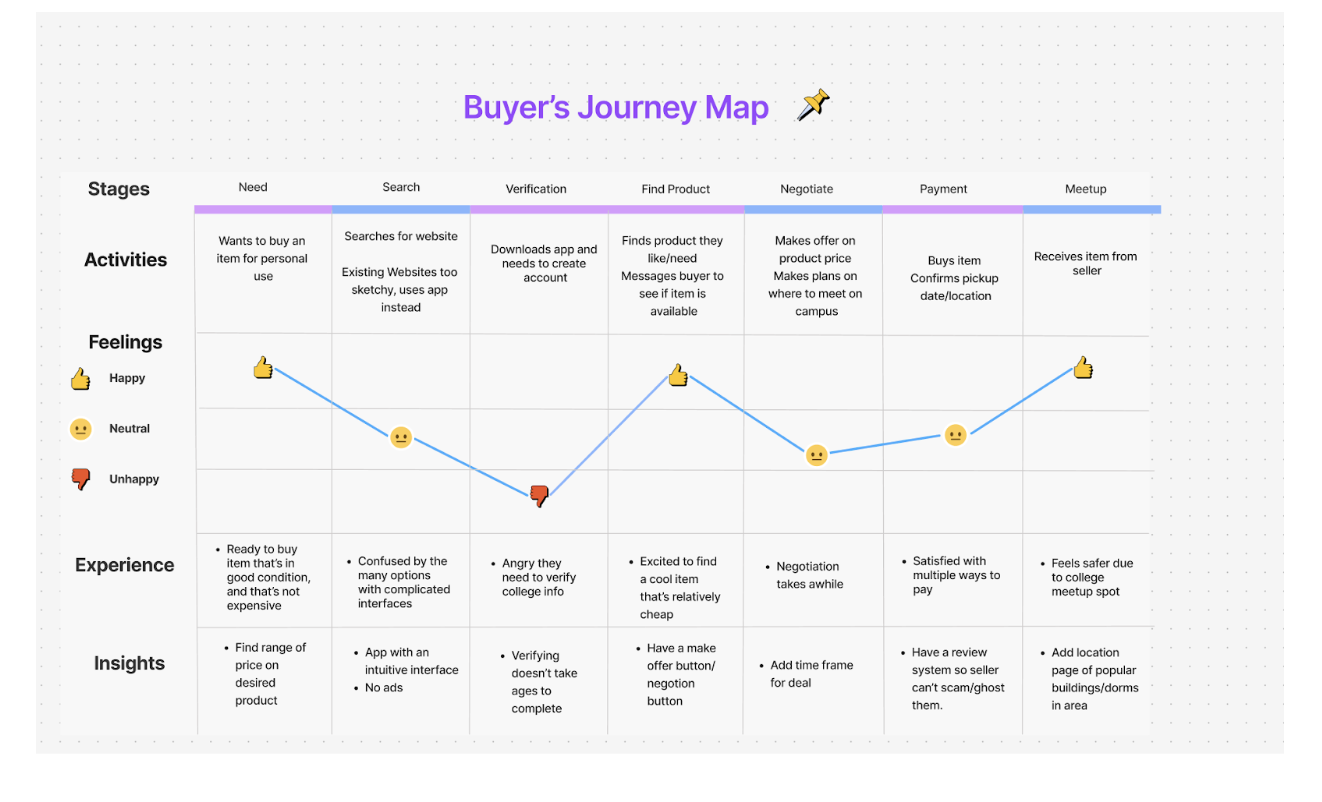
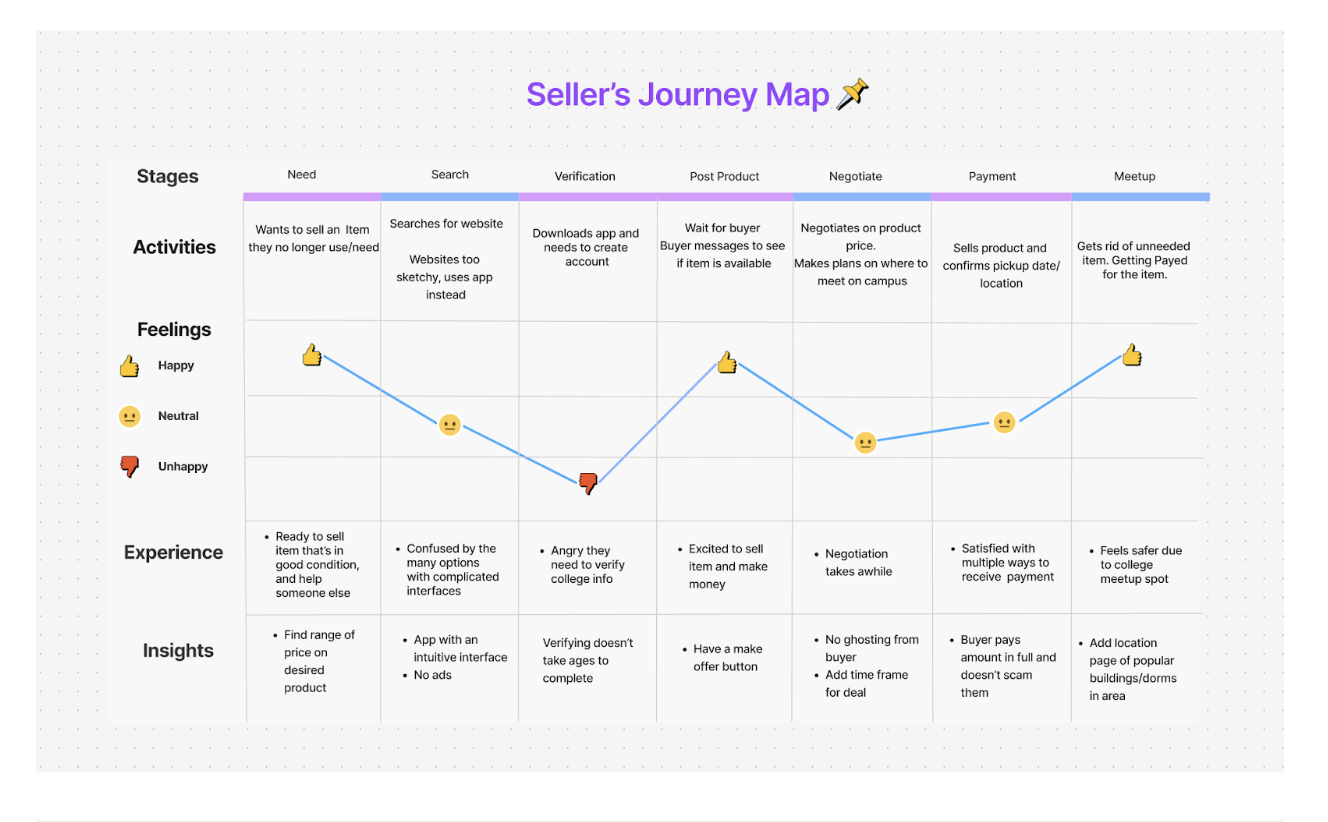
We mapped out both the buyer and seller journeys to understand the emotional highs and lows of each experience. The biggest pain point for both users was the verification stage, users felt frustrated having to prove their identity. This insight directly influenced our decision to make the .edu verification process as fast and frictionless as possible. We also identified "ghosting" as a major concern and designed a reliability rating system to address it.
Hi-Fi Design — The Final Vision
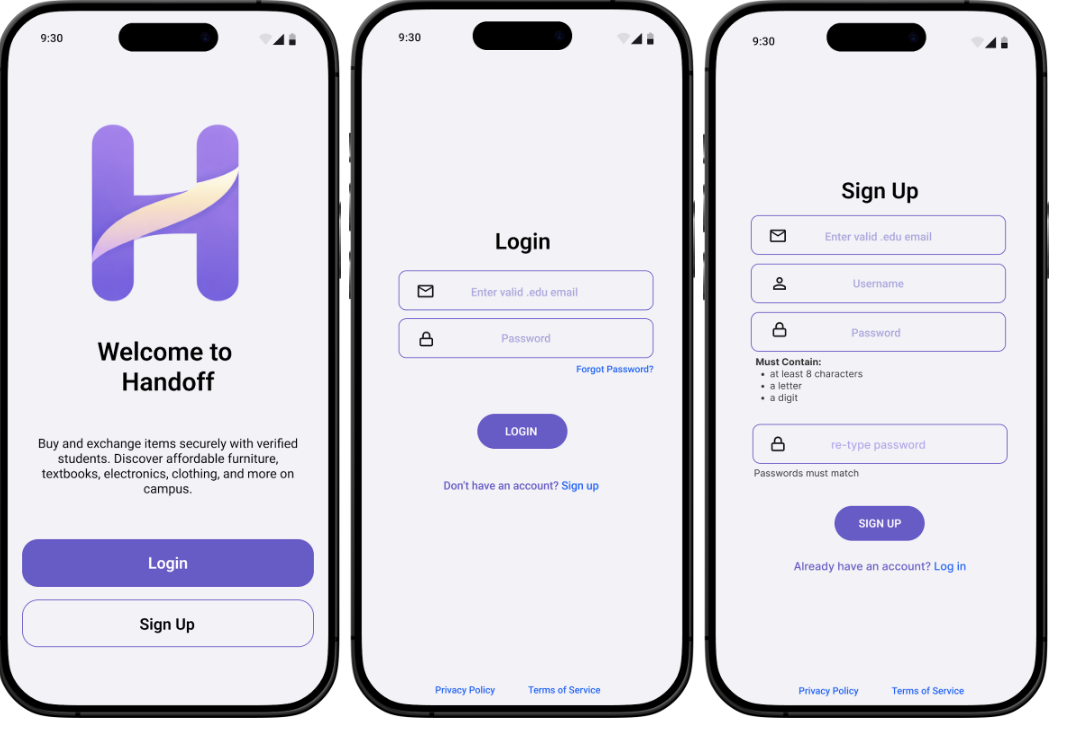
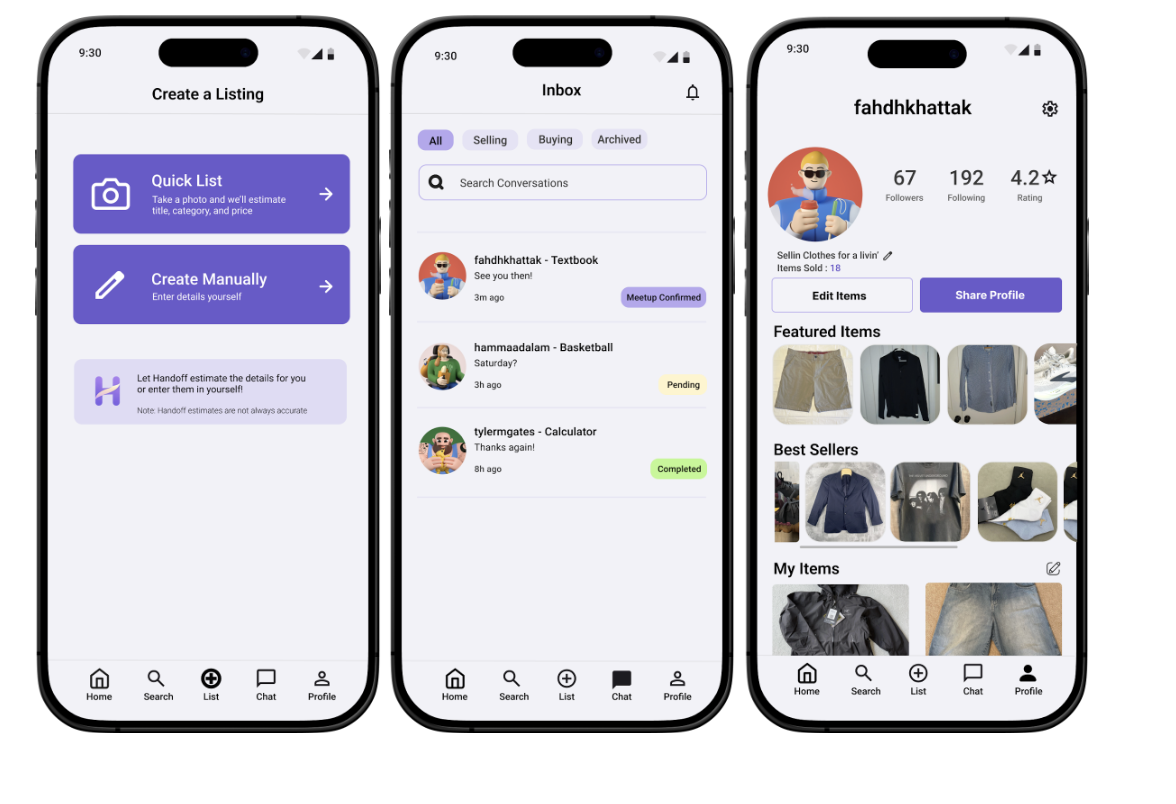
After several iterations in Figma, we arrived at a clean, purple-accented UI that feels modern and campus-native. The hi-fi designs cover the full user flow, welcome screen, login with .edu verification, sign up, home feed, item search, Quick List (AI-assisted listing creation), manual listing, inbox with transaction status tags, and a full user profile with featured items, best sellers, and reputation metrics.
Results & Impact
- Designed a complete hi-fi prototype covering 10+ screens and the full user flow from onboarding to transaction completion.
- Identified and documented 13 distinct user stories spanning freshman, senior, sorority, athlete, and safety-conscious student personas.
- Go-to-market strategy positioned Handoff to reach thousands of LSU students during peak move-in and move-out seasons.
- The .edu verification model directly addresses the safety gap that has led to real-world harm on competing platforms.
- Project received strong academic recognition and is actively continuing development beyond the course.
Key Features
- .edu email verification for exclusive student access
- Quick List — AI-assisted listing creation from a single photo
- Campus meetup location picker with popular on-campus spots
- Reliability rating system to prevent ghosting
- In-app messaging with meetup scheduling
- Ticket resale for LSU football games within a trusted network
- Post a listing in under 60 seconds
Tools & Process
What's Next
Handoff is currently in active development. The next phases include building out the full backend, implementing the .edu OAuth verification system, and launching a beta with LSU student organizations. The long-term vision is to expand to other universities, creating a nationwide student-exclusive resale network built on trust.
Steam Achievement Fetcher
DoneFull-Stack Web App — Development & Design Case Study
Steam's achievement system is powerful but buried in a clunky interface. We built a full-stack app to make achievement hunting fun, social, and competitive — then used AI tools to completely redesign the frontend when the first version fell short.
My Role & Responsibilities
- Contributed to backend development, Steam OpenID authentication, achievement fetching logic, and Firebase database integration.
- Built and iterated on the responsive frontend including tracking dashboards, leaderboards, and user engagement metrics.
- Led the UI redesign decision — identified the gap between V1's functionality and its visual quality, and drove the shift to AI-assisted redesign.
- Used GitHub Copilot and Anthropic Claude to accelerate the frontend rebuild, cutting estimated redesign time by ~60%.
- Ensured system functionality, data integrity, and end-to-end operational success across the full stack.
The Problem
Steam is the world's largest PC gaming platform with over 50,000 games and millions of achievements — but there was no clean, engaging way to browse, track, or get challenged by those achievements outside of Steam's own clunky interface. Our team wanted to build something that made achievement hunting fun, social, and competitive. The first version worked, but it wasn't something you'd be proud to show anyone.
The Story
The Steam Achievement Fetcher started as a straightforward full-stack project — Python Flask backend, Steam OpenID login, Firebase for user data, and a basic HTML/CSS/JavaScript frontend. The first version had a dark green background, plain text, and a minimal UI that technically worked but felt unpolished. It could fetch achievements, display them, and let users mark them complete — but it wasn't engaging.
We realized early on that the core functionality was solid but the experience needed a complete overhaul. That's when we made a strategic decision: instead of spending weeks manually redesigning every component, we would leverage AI-assisted design tools to accelerate the process. Using tools like GitHub Copilot and v0 by Vercel, we rebuilt the frontend in a fraction of the time it would have taken manually.
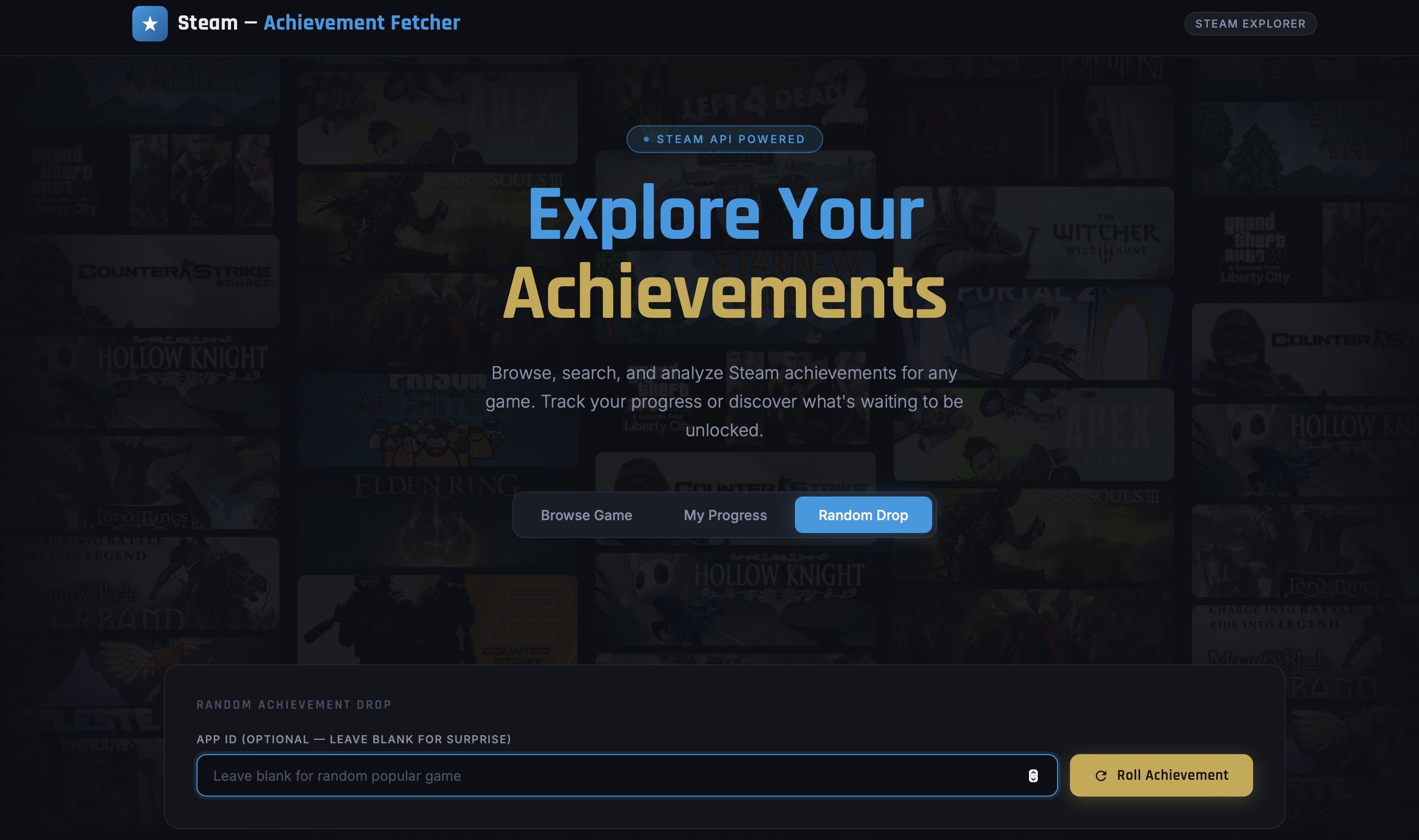
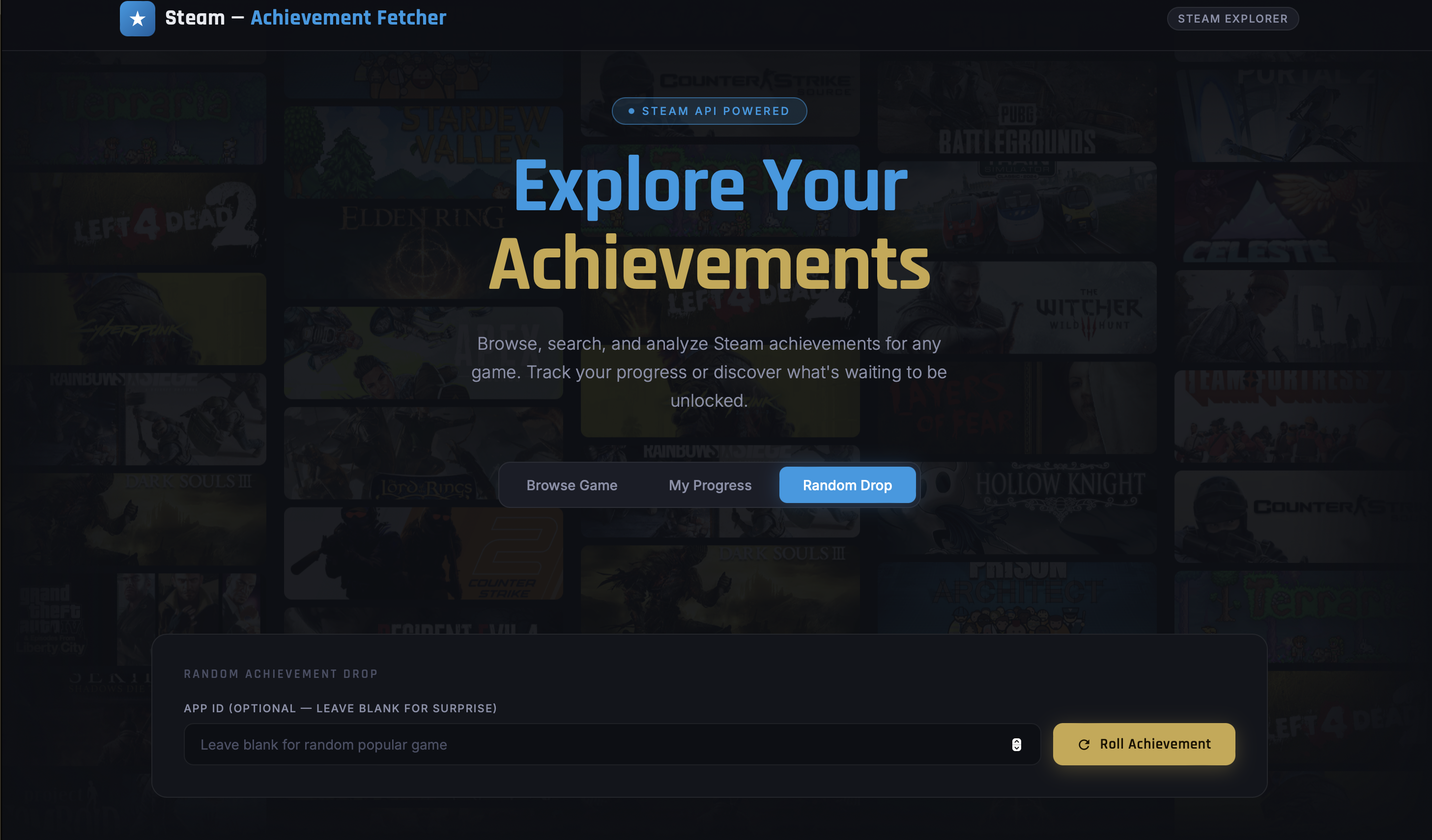
The result was a complete transformation, a dark, immersive UI with game cover art backgrounds, smooth tab navigation, a proper search system, popular game cards, and a polished achievement challenge experience. What started as a functional but basic app became something that actually looked like a product.
How AI Accelerated Our Workflow
When V1 was functional but visually weak, we made a deliberate choice: use AI tools strategically rather than rebuilding from scratch manually. Here's exactly how AI played a role:
- GitHub Copilot — accelerated repetitive frontend code like component scaffolding, API call patterns, and Firebase query boilerplate.
- Anthropic Claude — used to rapidly generate polished UI components (cards, tabs, search bars) that we then customized and integrated into our design system.
- What AI didn't do — the backend architecture, Steam OpenID integration, Firebase data modeling, and achievement logic were all hand-coded and deeply understood by the team. AI handled acceleration, not understanding.
- Result — estimated redesign time cut by ~60%, allowing us to ship a polished V2 within the project timeline.
Before & After
The original version (left) was functional but visually bare a green background, plain buttons, and no real design system. The redesigned version (right) features a dynamic game art background, tabbed navigation, a proper search interface, and a polished card-based layout for popular games.
Before — V1

After — V2
Results & Impact
- Successfully shipped a full-stack web app with Steam API integration, real user authentication, and a live leaderboard system.
- V2 redesign reduced visual complexity and improved UX clarity — moving from a bare green UI to a polished, immersive dark interface.
- AI-assisted redesign cut estimated development time by ~60%, demonstrating strategic use of AI as a productivity tool.
- System supports real-time achievement tracking, friend connections, streak monitoring, and competitive rankings.
- Project demonstrated end-to-end full-stack skills: backend API design, database architecture, authentication, and frontend engineering.
Technical Highlights
- Steam OpenID authentication for secure login
- Firebase backend for user data, streaks, and leaderboards
- Steam API integration to fetch real achievement data for any game
- Random achievement challenge system with game-specific support
- Friend connections and competitive leaderboard rankings
- Responsive frontend monitoring user engagement and system uptime
- AI-assisted UI redesign reducing development time by ~60%
Tools & Process
What We Learned
The biggest takeaway from this project was understanding when and how to leverage AI tools strategically. We didn't use AI as a crutch — we used it as a force multiplier. The backend architecture, API logic, and data systems were all hand-coded and deeply understood by the team. AI accelerated the parts that didn't require deep domain knowledge, freeing us to focus on what mattered. That balance — human expertise directing AI execution — is something I carry into every project now.